Language Translator

Search This Blog

Showing posts with label Australia Tourism. Show all posts

Saturday, January 29, 2022

Happy Chinese New Year!


The Chinese New Year & Spring Festival is one of the most important festivals in Chinese communities worldwide. 


It signals a new year, the end of winter, and the beginning of Spring. 


Before going to Australia, I didn't know much about the Chinese New Year.


But, after a couple of years in Sydney, which has a population of 1.2 million Chinese Australians, I started to feel a connection with them and a sense of their relevance to Sydney's society.


So, in 2019 when my Asian friends were celebrating a new year in February, calling it the year of the pig, I wondered, 'why are they celebrating the new year a month late, and what does it have to do with a pig?'


A zodiac pig from 2019 displayed in Sydney's Haymarket Suburb

Chinese communities celebrate two new years - the solar new year, on January 1st, based on our universal calendar (Gregorian), and the lunar new year, which falls between mid-January and February based on the Ancient Chinese (lunar) calendar.


The solar calendar keeps the Chinese community on track with the rest of the world, while the lunar calendar, based on moon phases, marks traditional Chinese festivals and holidays. 


Holiday dates determined by the moon cycles change yearly, like Easter.  


This year (2022), the Chinese New Year & Spring Festival falls on February 1st, the 2nd new moon after the winter solstice. 


However, festivities begin on Lunar New Years' Eve and end on February 15th with the Lantern Festival.


The Moon Phases


Chinese New Year and Lunar New Year are interchangeable terms in China, but not all cultures celebrating the lunar new year are Chinese. 


Koreans celebrate Seollal, and in Vietnam, Tet.  Whatever you call it, the standard greeting is Happy New Year, although it would make more sense to me if it were "Happy New Moon!"


Instead of a number, the Chinese calendar assigns one of its 12 animals from the Chinese Zodiac to represent the year in a recurring 12-year pattern.


The zodiac animals are the Rat, Ox, Tiger, Rabbit, Dragon, Snake, Horse, Goat, Monkey, Rooster, Dog, and Pig. 


While I don't rely on astrological forecasts or astronomy to understand my personality or predict my future, I do happen to know that my horoscope sign is Sagittarius, and my zodiac animal is the dragon.  Hehe.


2022 is the Year of the Tiger! 


Tigers are mighty, and like them, people born in this zodiac year are determined and persistent. 

However, they are also stubborn, rebellious, and arrogant.

Over a billion people travel long distances to attend family gatherings and enjoy a reunion good luck dinner of dumplings, fish, and other traditional Chinese foods & fruits on Chinese New Year's Eve - similar to how we in the black community eat black-eyed peas on New Year's Day. 

Chinese culture promotes the idea that folks will prosper and be happy if their lives are full of lucky foods, colors, and activities.

To prepare for the new year, they will clean their homes to rid them of any bad luck brought in from the previous year.


However, sweeping on New Year's day is forbidden, as it may sweep away good luck that came with the new year. 


Settling disputes and paying off debts is essential for a fresh start, and in Sydney, it is easy to find a Bank of China to help you pay off any outstanding accounts.


Bank of China in the Chatswood Business District


The lighting of fireworks or firecrackers during the new year promotes good luck because it scares away evil spirits.


New clothes are symbolic of a fresh start.  


Red is worn throughout the new year's holiday for luck (unless it clashes with your skin tone like it does mine!)   


If that's the case, wearing any bright color will ensure good things will happen. 


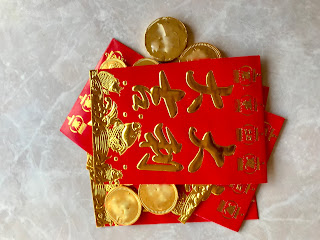
Kids receive 'lucky' money in red envelopes, which symbolizes the passing on of good fortune.

Lunar New Year Money Envelopes

A Chinese New Year tradition is the performance of the lion dance (also performed by dragons), which I saw with my Aussie friend, Farida, originally from Jakarta, Indonesia. 


Like other holiday traditions, the lion or dragon dances ward off evil and brings happiness, joy, and luck.


Lion Dance Crowd

Lion Dance in Sydney 

During the Lantern Festival, the last day of the holiday, children try to solve riddles written on lanterns. 


Chinese lanterns with riddles

Some families parade around with beautifully decorated paper light lanterns in the shapes of rabbits, a good luck zodiac animal. 


In the Circular Quay harbor area, giant inflatables featuring all twelve zodiac animals light up a pathway called the 'Lunar Lanterns Walk.'  


People and organizations all over Sydney celebrate the new year, regardless of heritage or brand.


The Australian Post even issued a new 2022 stamp in celebration!


While attending a church service at St. Andrews Anglican Church in Roseville on the first Sunday after the start of a Chinese New Year, the message "新年快乐", which means Happy New Year, greeted the congregation.


Afterward, I received a red envelope filled with chocolate gold coins. 


St. Andrews Anglican Church, Roseville


Chinese-Australian influence is everywhere down-under, and to the country's benefit.


Asian art, entertainment, cuisine, martial arts, and alternative medicine are all a part of the Australian experience. 


When I developed back pain, I jumped on the opportunity to try an alternative healing therapy like acupuncture, which was easy to find and helped a lot.  


Chatswood Suburb

Chatswood Suburb


There are usually beautiful displays throughout Sydney during the Chinese New Year.  

However, some activities have been scaled back this year due to the pandemic, but there will still be plenty to see in Sydney's Chatswood, Darling Harbor, Chinatown, and City locations.


Chatswood Surburb


Chatswood Suburb


Chatswood Suburb

Chatswood Suburb

Chatswood Suburb

Darling Harbor, Good Luck Dragons

Chinatown Lunar Lanterns

Circular Quay Lunar Lantern


Sydney is a great place to learn about other cultures. 


Western Europeans, North Americans, Portuguese, Arabs, Indo-Chinese, Indians, and South Asians all call it home.


Since traveling there, I've developed a broader worldview and appreciation for people and cultures I mostly ignored in the US.  


Now that I've learned a lot about them, I would like to teach them more about me.


After all, black history month, like the Chinese New Year, also starts on February 1st.


Celebrating New Year's day twice . . .


The Year of the Tiger . . .


Lion's dancing on stilts . . .


Sydney is NOT Kansas!


If you enjoyed reading this post, stay tuned for more about how I see Sydney.


To leave a comment, please log into google or leave me a note using the form on the right side of the page.


Friday, December 24, 2021

Boxing Day

A few public holidays in Sydney are unfamiliar to me, like Australia Day, Anzac Day, and the Queen's Birthday, but none more than the one that falls on the day after Christmas, known as Boxing Day!    


On this day, folks seem almost as excited as they are on Christmas! 


I didn't get it, especially when I heard the holiday ritual consists of trashing boxes leftover from Christmas and returning unwanted gifts to the store.   


I thought to myself, it can't be that simple, and I found out it wasn't.


Boxing Day is not Australia-specific - it's a British public holiday also celebrated in other Commonwealth countries like Australia, New Zealand, South Africa, and Canada on the 26th of December. 


The proper greeting is Happy Boxing Day!


The holiday has nothing to do with the actual sport of boxing; instead, similarly to how Americans tip service providers at Christmastime, like newspaper carriers and handypersons, theories about the holiday come from the English tradition of giving boxed gifts to service people.  


Dating back to Victorian-era England, the wealthy would give servants, who worked on Christmas Day, the next day off, along with boxes of cash, gifts, and food to share with their families. 


Also, in the 1800s, the early church had a tradition of collecting donations in Alms boxes to distribute to the poor on St. Stephens Day, the Christian holiday that falls on the 26th.


Traditions evolve over time, and with progressive social changes, Boxing Day now seems to have less to do with giving and more to do with spending.


Boxing Days sales are equivalent to the ones we have on Black Friday. Stores open at 6 am. but shoppers start queueing hours earlier.


Westfield Chatswood Shopping Center

Westfield Chatswood Food Court

But not everyone goes shopping on that day.


While visiting my co-mother-in-law, I was invited to a neighbors Boxing Day barbecue. 


I was excited because my curiosity about the day could now be satisfied by a first-hand experience.


Neighbors house


When I arrived, CP time, their family and friends of all generations had packed the house.


The party took place inside and out, and included lots of food, especially barbecue and plenty of eskies (coolers) full of cold drinks and beer.


Lots of grilling

Prawns (Shrimp) and Oysters


I met the neighbor's sister in the back garden. She told me that the annual family barbecue on Boxing Day gave them a chance to see everyone and to relax after the Christmas commotion. 


She mentioned that she worked for an Australian government agency and was happy to have the day off, too!


I learned a lot about her job, love of family, and her culture, as she was Indigenous (Aboriginal)In return, she got an earful of what it was like to be a Black American in Sydney. 


It reminded me of a 4th of July family picnic back at home,


There was not one mention of boxes, but plenty to say about the cricket match, broadcasting loudly from the television inside the house. 


Cricket Match at the Melbourne Cricket Ground

Cricket is one of Australia's favorite sports and the Cricket Test Match, which begins on Boxing Day, is the highlight of the cricket season. 


The Hobart Yacht Race, which starts in Sydney and ends in Hobart, Tasmania, is another sport that grabs the attention of Aussies on the 26th.


Regardless of where you go on that day, restaurants, bars, or family barbecues, you will be within earshot of televisions broadcasting sports, which are central to Australian popular culture.


Cricket match broadcasting live

Cricket match broadcasting live


Australia's sunny and hot climate provides plenty of opportunities to be outside and active, and their sports promote mateship.


When my grandson, Jethro, was three, he received a cricket bat for Christmas from an Aussie neighbor who loves the game.


He's eight now and never picked up the sport, but at least he picked up the bat!


My grandson, Jethro at 3 years old

This year, Christmas falls on Saturday the 25th, Boxing Day is on Sunday, the 26th, and some businesses and government agencies will close on Monday, the 27th, and Tuesday, the 28th to observe the public holidays.  Wow, that's two more days off!


I get it now. 


When the excitement of Christmas day starts to fade and post-holiday blues begin to set in, Boxing Day is the holiday after the holiday. 


For all of those who don't trash boxes, it's a time to relax with family, attend barbecue gatherings, go shopping, and overindulge in sports! 


A day to trash boxes . . . 


Boxing Day sales . . . 


Cricket matches  . . .


Sydney is NOT Kansas!


If you like this post, don't forget to leave a comment below or send me a note using the form on the right!  Thanks for reading, and stay tuned for more!


Saturday, September 1, 2018

Australian Cigarette Packaging

Yipes! Just when I thought nothing else here would surprise me, something did! 


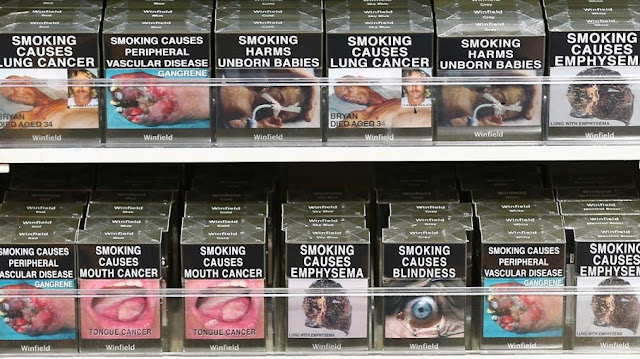
Australia packages its cigarettes in dark-colored boxes covered with gruesome pictures and horrific warnings about the dangers of smoking.  


Each pack highlights specific smoking-related diseases to drive home the message that smoking causes fatal illnesses.  


Rheumatoid arthritis, acute leukemia, ectopic pregnancy, kidney cancer, infertility in women, diabetes, erectile dysfunction, blindness, bladder cancer, and peptic ulcers are all diseases that made the cut and appeared on the various boxes. 


Various brands of cigarettes packaged in Australia.


The objective of the packaging is to force smokers to look at the images and read the health warnings repeatedly


Each pack is more frightful than the next, but the worst, in my opinion, is the corpse's foot and the warning SMOKING KILLS in large letters.


Wow, I don't see this back home in the US. 


Australia's goes to war again tobacco products
Australia's strategy to make smoking less appealing

Smoking isn’t illegal in Australia, just demonized by mainstream society and the Australian government. 


There are plenty of Aussies who smoke in outdoor spaces and the privacy of their homes.


However, it’s not allowed in enclosed public places in every state and territory in the country.  


It is also prohibited n personal vehicles that carry children under 16. 


A smoker with Australia’s plain tobacco packaging with a health warning. AAP Image/Sam Mooy

Tobacco smoking, which includes cigars, loose-leaf & shisha/waterpipe tobacco products, is responsible for more cancer deaths in Australia than any other single factor.  


Smokers have an increased risk of developing heart disease, diabetes, stroke, cancer, renal disease, eye disease, and respiratory illnesses.  


But tobacco companies don't talk about the health risks associated with their products.


Cigarette advertising is illegal everywhere except for the ads against smoking plastered on the actual pack.  


For years the tobacco industry has taken advantage of this loophole to market their product through their box design, color, and descriptive terminology such as 'low tar,' 'light,' and 'mild.' 


Australia's pack advertising has fought back! 


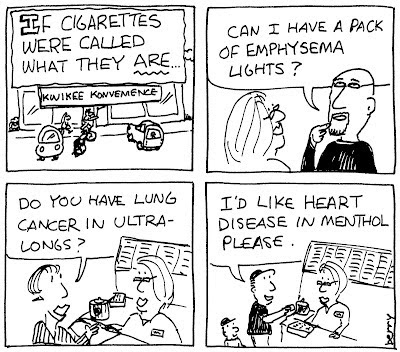
CartoonistJeff Berry
Original Cartoons by Jeff Berry

Reducing the smoking rate is in the interest of public health, so the Australian government introduced legislation to Parliament that would fight fire with fire. 


The controversial Tobacco Plain Packaging Act of 2011 required tobacco products to be in dark-colored packaging with gut-wrenching graphics & actual health warnings.  


The legislation passed, and the plain packaging law became law in December 2012.


Today all tobacco products are standardized in Australia, i.e., they all look the same. Very Confusing?


But have they gone too far?  


Not for Australia, which is a nanny state by American standards, a term the Brits came up with to describe an overprotective government, especially concerning health and safety.  


Some countries will let you do what you want and expect you to do the right (safe) thing. Not here: they pass laws to protect you from yourself.  


Australia is a member of the World Health Organization (WHO), an agency of the United Nations that focuses on international public health.  


The WHO held a Framework Convention on Tobacco Control (FCTC) in 2003, and Australia became a signatory (co-signer). 


They were now accountable for meeting outcomes, including reducing the smoking rate in Australian and Aboriginal communities.  


The Plain Packaging Act was one measure Australia took to fulfill its obligation.   


Plain packaging doesn't just apply to tobacco products manufactured down-under. Any tobacco company that wants to do business in the Aussie market must comply.


Changing the packaging was a problem for the big tobacco companies, like the Altria Group, Inc., aka Philip Morris International, the  biggest cigarette company in the world and the maker of the best-selling cigarette, Marlboro. 


They took Australia to court - twice - to argue that plain packaging would diminish the value of the company's trademark.  


They lost the first battle in an Australian courtroom and the second in an international arbitration court.  The court criticized the case for being an "abuse of rights." 


Philip Morris International had to be “hot” to see their logos, bright colors, and expensive package designs exchanged for dark shades, grotesque images, and death warnings. 


While the outside of the packages may leave a bad taste in your mouth, the actual cigarettes are the same.  


Although, some folks have also complained about the taste.


Tobacco companies deny changing the make-up of their cigarettes.


Marlboro's packaging stages.

In US convenience stores, retail merchants showcase their tobacco products on walls  behind checkout counters.  


These visual display areas are "power walls" because they can draw customers in and entice them to make additional purchases.  


"Power walls" draw the attention of children and adults alike, leaving some children to think that because the products are so prominently displayed, they can't be dangerous.  Seriously?


In the US, convenience stores below tobacco products are easy to identify, at a glance, by brand or color, and prices are in full view.  


US convenience store cigarette 'power wall.' 

That is not the case in Australia, where tobacco cabinets are as scary as the packs. 


The Aussie "power wall' showcases anti-smoking messages and telephone numbers to quitlines.  Even at a glance, it is easy to see that the word quit appears twice.  


There are no bright colors, familiar logos, or trademarks in view - only a list of cigarette brands for sale and their prices typeset in a medium-sized font.


Not appealing, but you get the message.  


Aussie convenience store cigarette 'power wall' - not at all subtle.


According to the World Health Organization, tobacco excise (tax) is the single most effective way to encourage tobacco users to quit.  


The Australian government has been raising it by 12.5% each year. 


They are already among the most expensive cigarettes globally, and the government's goal is to hike the price up to $52.00 for a 20-pack by 2020.


Cartoonist John Ditchburn


Tobacco products cost the government $31.5 billion each year in health and economic costs. 


They collect around 8 billion in tobacco excise, which is good since Australia provides universal (free) health coverage.

The question remains: Does cigarette packaging encourage quitting?  


Some Aussies say they quit because of the pack, while others say they have become desensitized to the images, and the packaging doesn't matter. 


The government has reported a reduction in tobacco use, but it may take years before anyone knows if it's because of plain packaging. My bet is on the excise.


Meanwhile, other countries are considering adopting this law, maybe even yours.


Grotesque images on cigarette packs. . .


Tobacco products behind closed doors. . . 


Forty dollars a pack? . . .  


I am NOT in Kansas!