Search This Blog

Showing posts with label indigenous. Show all posts

Saturday, May 18, 2024

"Australian Laughing Kookaburra"

Australian Laughing Kookaburra

A few summers ago in Sydney, I was standing in my co-grandmother's beautiful back garden, eating a sausage sandwich and admiring her breathtaking view, when a Kookaburra swooped down, grabbed the sandwich out of my hand, and flew away!  

It happened so fast that I had no time to react, so I just stood there flabbergasted!

Photo of my co-grandmother's beautiful back garden and pool.

The Kookaburra is a big bird, 18 inches long from beak to tail, and it’s the largest in the kingfisher family.

They can be aggressive when hunting or cornered but laid-back and very comfortable with people who pose no threat, so I was never in danger from a bird attack. 

My sandwich, though, was an entirely different matter.

A Kookaburra, calculating where it will swoop next!

These birds are exclusively carnivorous (meat-eaters) and will grab meat right off the grill while cooking.

Their heavy beaks work like tweezers, making stealing food easy.  

Even though they are kingfishers, they eat more insects, spiders, frogs, reptiles, snakes, birds, rodents, etc., than fish.  

However, they occasionally snatch goldfish out of backyard aquatic ponds.

My daughter, proficient in DIY, designed and dug out her natural backyard pond. She has Kookaburras in her garden, so she bought a crocodile head to warn Kookaburras to stay away!    

A crocodile head will deter a Kookaburra!


Native to Australia, the Kookaburra is one of the country's most identifiable birds. I've spotted them perched in low and high places everywhere in Sydney. 

My son-in-law's favorite place to nap is on the front garden hammock, although he may not want to rest there with the Kookaburra. 

The colors in the bird's plumage complement each other. Its back is a stunning brown, and on each wing is a striking patch of blue. Its chest is creamy white, and its tail is reddish-brown with white feathers on the tips.

This photo shows the bird's beautiful color harmony!

A Kookaburra, spreading its wings!

It's a stocky bird with a thick neck, a buff-colored beak shaped like a boat, and a distinctive brown strip that crosses both eyes like a mask.

They are intelligent birds and can remember people's faces, which makes me wonder if this clever fellow will remember I was the sucker eating the sausage sandwich.   

The creamy chest of the Kookaburra pops against the blue Aussie sky.

The Kookaburra captured my attention again while I was vacationing with my family in a houseboat on the Hawkesbury River just outside Sydney.

Our beautiful weekend houseboat included a full kitchen, barbecue, fishing rods, bedrooms, a bathroom, a large upper deck, and lower decks wrapped around the boat.

Our beautiful houseboat!

To avoid running aground, we used dinghies to explore river areas too narrow or shallow for the houseboat. 

We would take the dinghy to get off the boat, dock it on the river's edge, and enjoy some Hawkesbury land tourist activities and shops. 

Dinghy

It was very dark on our first night on the water, and with no light coming from other sources, the night sky was majestic! 

Because Australia is in the Southern and Eastern Hemispheres, its galactic and intergalactic objects in space differ from those in the U.S. because the states are in the Northern and Western Hemispheres.

The brightest stars in the galaxy, like Sirius and Canopus, are in the Southern Hemisphere.

The commonly known Southern Cross constellation, which can also be seen from Australia, is depicted on the country's national flag.  


The Australian National Flag: The star that stands alone on the left has 6 points, each denoting the six states of Australia. The remaining five stars on the right represent the star constellation of the Southern Cross. 


Looking up from the top deck of the houseboat, I had never seen so many lights.  

I was mesmerized by the starry night sky when the sound of a crying baby from a distance diverted my attention.

The crying quickly changed into a chorus of screeches, whirring, and cackles resembling the sound of a troop of chimpanzees in the deepest part of a jungle. 

Right then and there, I knew what I knew: I was not in the U.S., and that was no crying baby!


Listen to the Kookaburra Cackle!

⬇

Credit - Kookaburra Sound: 'Supplied, courtesy of NSW Dept of Climate Change, Energy, the Environment and Water.  (https://www.environment.nsw.gov.au/topics/animals-and-plants/native-animals/native-animal-facts/laughing-kookaburra)

Credit - Photo: Sistah in Oz
__________________________________

Stereotypical or not, like many Americans, I'm afraid of Australia's wildlife, many of which are deadly and found nowhere else on the planet. 

So, when I heard creepy cackles coming from "Lord knows what" and "from who knows where," that was the last thing I needed, especially while docked in uncharted waters on an Australian river!

I asked my son-in-law about the eerie sounds, and he said, "Oh, that's just the Kookaburra's laughing."

My first thought was, "Kookaburra! That's that cheeky carnivore that ate my sandwich!"

My second was: "Not funny!" 

Kookaburra perched on a goalpost at puppy park, looking back.

While the Kookaburra's actual name comes from the aboriginal name "guuguuberra," it has other nicknames, like "bushman's clock" or "breakfast bird." 

Their outrageous calls are so dependably vocal at dusk and dawn that you can set your watch by them - and loud enough that any creature with ears can hear them from miles away.

Bev, a friend from England who frequently visits Sydney, refers to the Kookaburra as the monkey bird, which cracks me up every time she says it!

This Kookaburra is showing off his best side.

But the common nickname for this cheeky bird with a raucous voice is "Laughing Kookaburra." 

It's got to be the coolest bird on the planet. 

It's good-looking, has facial recognition abilities, a human personality type (thief), and outstanding vocal skills that mimic chuckling, crying, and laughter—which, when strung together, sounds like monkey chatter! 

Kookaburra at the Oval car park.

If you're old enough to remember the movie "Tarzan The Ape Man," starring Johnny Weissmuller like I am, the jungle sounds used in the film came from recorded stock sound effects of Kookaburras.

These recordings are also in many other movies involving jungle scenes, such as "The Raiders of the Lost Ark," "Cape Fear," "The Lost World, Jurassic Park," "The Twilight Zone," and many more, including Sistah in Oz's favorite, the haunted forest scene from "The Wizard of Oz!"  

Forest areas in Australia are called "bush!" 

Australia's indigenous communities regard the Kookaburra as a messenger of good luck, joy, happiness, and fertility - good vibes!

Before visiting Sydney, I only knew about Kookaburras from a song I learned at Brownie camp, "Kookaburra Sits in the Old Gum Tree." 

Marion Sinclair wrote it as a nursery rhyme.

My sister, Terry, and I loved singing the song at camp, but I admit I only really understood the lyrics after I got to know the bird! 

A Kookaburra sitting in a gum tree, aka, eucalyptus.

A crafty meat-eating bird that steals your lunch  . . .  

A talented, noisy bird, skillful at mimicking a repertoire of jungle sounds . . . 

A brilliant bird with an extraordinary memory that can recognize human faces . . . 

. . .  I am NOT in Kansas!


Please sign into Google to leave a comment.  


Monday, January 23, 2023

Uluru/Ayers Rock

In celebration of my birthday, my daughter told me to pack a bag because she and her hubby were taking me on a surprise trip! 


She advised me to include walking shoes, a swimsuit, and a good hat, preferably with a mosquito net.  I was worried about the mosquito net.


On the morning of my birthday, she announced! "We're going to Uluru! 


Uluru is a sandstone monolith formed over 500 million years ago when tectonic activity, rainwater, and wind caused a mountain range to erode.


For years, Uluru/Ayers Rock had been on my bucket list. So I was thrilled about the trip. 


It's Australia's most famous icon and is historically, geologically, culturally, and spiritually significant to Australians. 


Located in the southern region of the Northern Territory known as 'the Red Centre', Uluru rises to a whopping 345 meters above a flat desert floor stained red.  


The red pigmentation of the ground comes from the high iron content in the dirt. The iron is constantly rusting because of the chemical process of oxidation. 


The sheer image of this massive red rock sitting in the middle of a flat red desert plain makes a statement.


Most of central Australia's land is sandy.  Uluru only gets 12 inches of rain yearly, and evaporation occurs quickly, with desert temperatures ranging between 100 - 106 °F. 


The lack of rain makes the environment arid, harsh, and uninhabitable for most life.


Looking out of my window during my three-hour flight from Sydney, I quickly noticed the absence of highways, electrical poles, swimming pools, houses, or buildings - nothing down there - just red desert plains as far as I could see!


The desert plains below are not habitual. 


We lodged at the beautiful Ayers Rock Resort - Sails in the Desert Hotel in the township of Yulara (population 1,099), the only area of developed properties created to accommodate the folks who work at the resort and the 250,000 people who come yearly to see the rock. 


The Sails in the Desert entrance


Resort rooms


The Desert Sales Resort was built in 1976 and can accommodate 218 guests.

There is a gorgeous canopy of Ghost Gum trees throughout the resort.  They are spectacular during the day, and so white they appear to glow at night.  Aboriginals believe their glow is proof of living spirits.


Indigenous Aussies use various parts of the Eucalyptus trees for different reasons, some medical.


Gum trees in the courtyard


Resort grounds - in the background are beautiful ghost eucalyptus trees shading the property.


A large pool, pool bar, and outdoor dining are perks at the hotel.


A great lounge area with oversize chairs surrounds the pool.


The indoor dining experience and lobby include plenty of aboriginal designs.


An emblem that represents Australia is the Boomerang, a unique hunting tool.


Aboriginal art is for sale in the lobby.


At night the pool is lit, and when necessary, heated. 


View of the red sandy road and desert grasses from my patio deck


After checking in, we drove around - that was the first time I saw Uluru in person, off in the far distance.


I had seen it so many times in magazines and on the internet, so I knew what to expect. 


However, seeing it in person was an entirely different experience. The ancient monolith and the landscape looked untouched by time, and I felt like I was a part of something extraordinary.


I couldn't believe this was my birthday present, and the only thing I had to do to earn it was to turn one year older!


We drove in for a closer look.


From any angle, the picturesque Uluru is striking.


Close view of Uluru from the road


The First Nation Australians, the Aboriginal and Torres Strait Islander peoples who belong to the Anagu group, have lived on the land for over 30,000 years and believe that the rock is a living and breathing landscape and the handiwork of their ancestral spirits who created it and everything else in the world.


I was as excited as I'd been the first time I saw the Sydney Opera House.  


For a long time, Uluru was called 'Ayers Rock'.  In 1873, a white explorer saw the rock and named it after Sir Henry Ayers, Australia's Chief Secretary.


This action worsened already strained relationships between black and white Aussies. 


To mend relations and as a sign of respect, in 1976, parliament passed the Land Rights Act enabling First Nations Australians to reclaim their land and restore its name to Uluru, meaning 'great pebble.'


The names, Uluru and Ayers Rock are interchangeable.


Nineteen miles west of Uluru is Kata Tjuta, another monolith shaped into a series of domes and standing 546 meters above the plain.  It was more spectacular and more prominent than Uluru. 


For me, who wanted to see one rock in the middle of the desert, seeing two was a surprising delight! 


Kata Tjuta/The Olgas

Like Uluru, it had also been claimed and renamed 'The Olgas' by white explorers until the Aboriginal Land Rights Act, when its original name Kata Tjuta, which means 'many heads,' was restored.  It is composed of 36 massive rocks and stands 546 meters tall - that's higher than Uluru.  


To my surprise, Uluru and Kata Tjuta are not separate outcrops. 


Instead, they are land icebergs extending 2.5 kilometers below the surface, joined together by underground rock formations.  


In other words, Uluru and Kata Tjuta are the exposed tips of one massive subterranean formation.  


Who knew?


We decided to visit Kata Tjuta first and save Uluru, the main attraction, for last.


Kata Tjuta & Uluru - underground diagram


I had heard that the Outback had a severe fly problem but only experienced it at Uluru - the heart of the Australian Outback!


Baby flies swarm you the second you step outside; they are especially fond of eyes, ears, and mouths. 


The mosquito net in the Outback is a fly net, and like your American Express Card, if you are going to the desert, don't leave home without it! 


Me and my best friend, the fly net!


We started at the viewing site before we drove the car closer to the monolith to begin a leisurely walk up and over the hilly surface. 


Kata Tjuta's viewing site


My son-in-law walked ahead of us, and I decided to try to catch up.  As he walked higher, he disappeared from my view.


My son-in-law, me, and my grandson hiking around Kata Tjuta 

Rather than turning back, I continued. After all, coming here was my birthday trip and a fantastic adventure, and I didn't want to miss a thing!


Me slowly climbing Kata Tjuta.


I am not a hiker and don't like heights, but the tranquil atmosphere around the rocks relaxed my fears.


We seemed to be the only people out there, which should have been creepy, but wasn't.


I was in awe of the terrain and how the ground and monolith colors blended like oil on a canvas.  


It was a lot to absorb.


Sensing the power of the rock in silence, I breathed deeply, said a few prayers for family and friends, and took in the view.


I looked out at the vast expanse and felt a spiritual connection to Mother Earth.


Me in awe of the rock

What I saw looking out at the expanse 

Miles and miles of red rock and sand


Kata Tjuta dome openings create passageways

The landscape around Kata Tjuta is called the living desert, and rightfully so - while not lush, there is plenty of native grasses and flowering plants growing out of the red sand and from between the hot rocks.


Desert landscape signage


Desert Flowers


Drought-resistant desert flowers

The green vegetation contrasted against the red sand

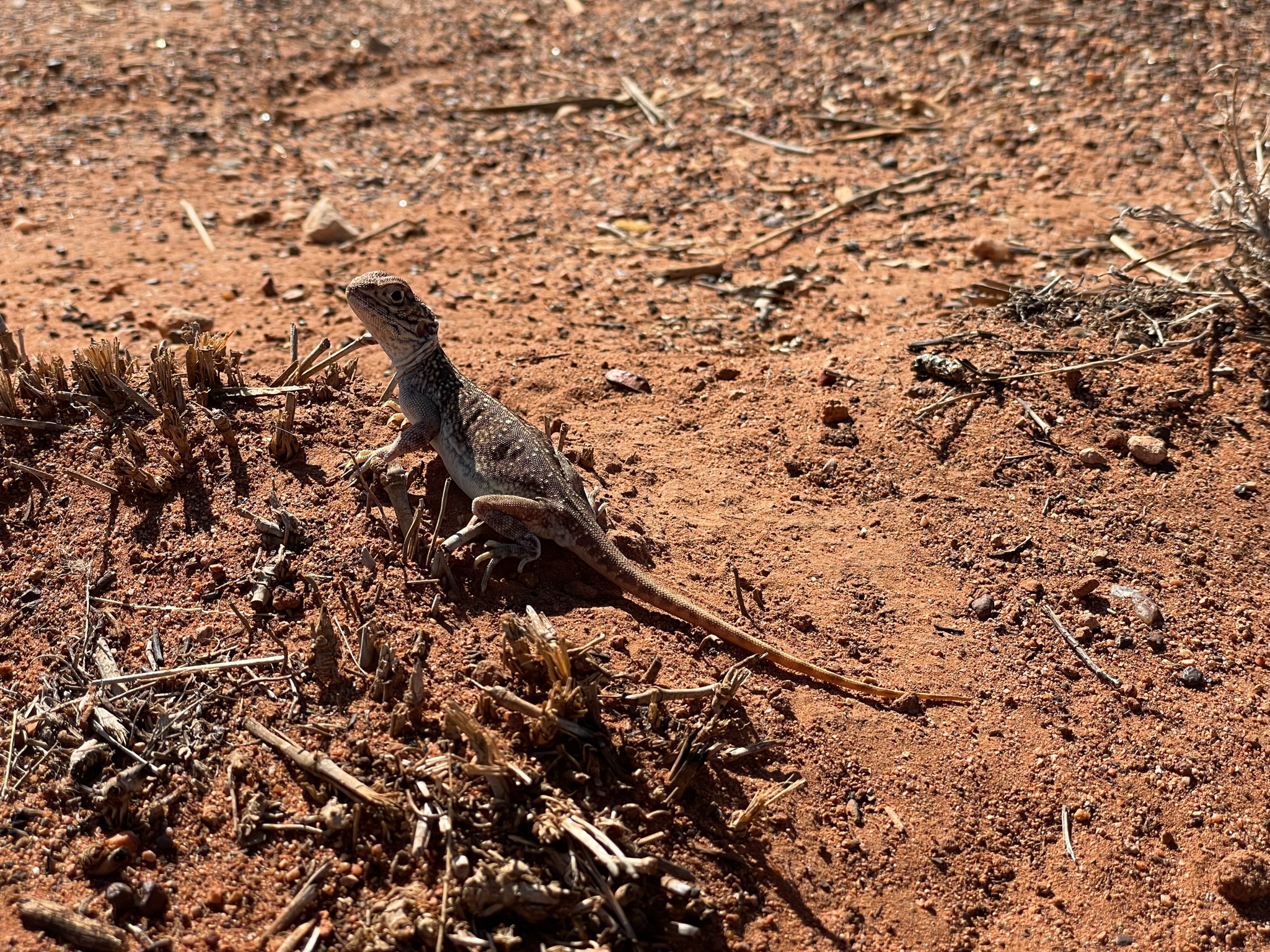
I had heard that the desert is home to dingos, red kangaroos, wallabies, mulgaras, moles, and mice; but the only critter that showed up for us was a desert lizard. 


Desert lizard


Small insect mounds


On our way down the outcrop, we saw a warning sign stating it was unsafe to be on the track after 11:00 am if the temperature reached 96 °F or higher. 


December is a summer month in Uluru; the temperature was soaring past 100 °F every day when we were there.


We learned!


Me at the 11 am warning sign; after 11 am

Between May and September, when the desert temperature is in the 70's and 80's, are the best times to visit. We were there in December, which is the summer & the off-season.

We woke up the next day at 4 am to tour Uluru before it got too hot and to catch the changing colors of the rock caused by the sun's movements. 

The rock can appear in different variations of grey, red, rust, orange, purple, and brown, depending on the time of day.


Even in the dark, Uluru looks mystical.


Sunrise


Uluru's vivid color just after sunrise


The constantly changing colors of Uluru


It's hard to be cute wearing a fly net!


When we were finally within the distance of Uluru, it was early enough in the day to take the 10km walk around its base, which takes 3 1/2 hours.  


At every turn, the rock continued to appear in different colors. I hadn't noticed while at the rock, but the camera does not lie!


The ground color complimenting the monolith


My grandson - standing in front Uluru


The different shades of the rock at various times of the day are lovely!

View of how the sun affects the color of the rock

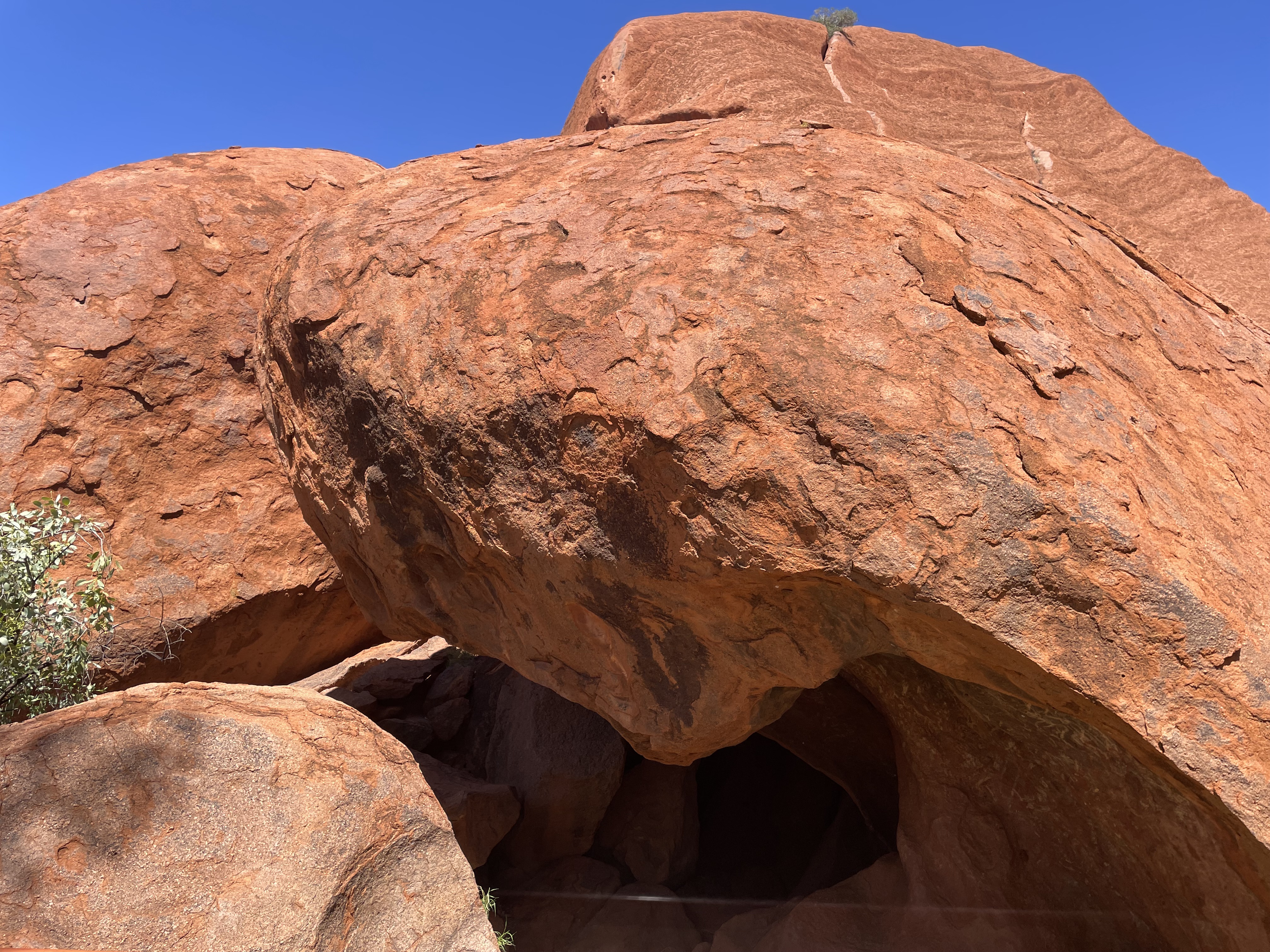
Although the rock appears to have a smooth surface with just a few ridges, up close, it's rough and full of indentations and potholes - believed to be markings from indigenous ancestors.


Surface changes


Outcrops and potholes throughout


Me standing in front of rocks, many potholes, and caves


As the morning wore on, each time we passed a sign marking sacred areas, our base walk through the harsh terrain in 100-degree weather seemed more like a pilgrimage. 


A signpost reminder that this area is sacred


Well into the walk


The rock towering over us as we walk


We found plenty of opportunities to stop and hydrate.  During one rest stop, my grandson had a great time playing with Magpies. 


Resting area


Magpies in search of food


I was excited about the cave wall drawings we saw.  I heard that the caves were full of pictographs, some depicting dreaming stories still used today in sacred ceremonies and rituals held inside the caves.  


This is one of the reasons the monoliths and surrounding grounds are sacred. 


Cave drawings


Cave drawings


Looking at the rock reminded me of Psalm 18:   


"The Lord is my rock, my fortress and my deliverer; my God is my rock, in whom I take refuge . . ."


Entrance to one of the many caves - off limits to tourists


When we had come to the end of our base walk, I had only one thing left to do - touch the stone! 


But unlike the movie "Outlander," I wasn't physically transported to the past.  However, I did feel a connection to the Indigenous people.


The touch


Tourists seeking to experience the Australian Outback are attracted to this ancient secluded place where they can view rugged landscapes, ancient formations, and native wildlife surrounded by the beauty of a red desert floor.


However, like at the beach, don't take the sand. 


There is a myth that removing sand, twigs, rocks, or any natural debris from Uluru can bring bad luck. 


Desert sand scene


Desert sand scene


Desert sand scene


Desert sand scene


Desert sand scene


Desert sand scene


Desert sand scene


I took this picture from a resort room balcony - Uluru looms purple!


On our last day at the resort, we listened to a live presentation on edible plants growing in the desert. 


Jokingly, the presenter said we could eat anything out there - at least once. 


Desert foods demonstration 


We purchased souvenirs from the resort shops, where we saw signs soliciting support for the aboriginal community.


Anagu Communities Foundation sign


I purchased a piece of original aboriginal art from a resident who spoke with a heavy Pitjantjatjara or Yankunytjatjara (native) accent.


She told me that the painting depicted the aboriginal story about the seven sisters, who ran away from the love of an ancestral Jakamarra man by turning into fire and ascending to the heavens to become stars.


I was so excited to add this piece from Uluru to my small aboriginal art collection.


The dots above represent the Seven Sisters, and below, one man.


Afterward, I posed for a photo with a local man I had seen earlier walking barefoot throughout the shops. Aboriginal people walk barefoot to connect with the earth.


Me, Sistah with a resident of Yulara


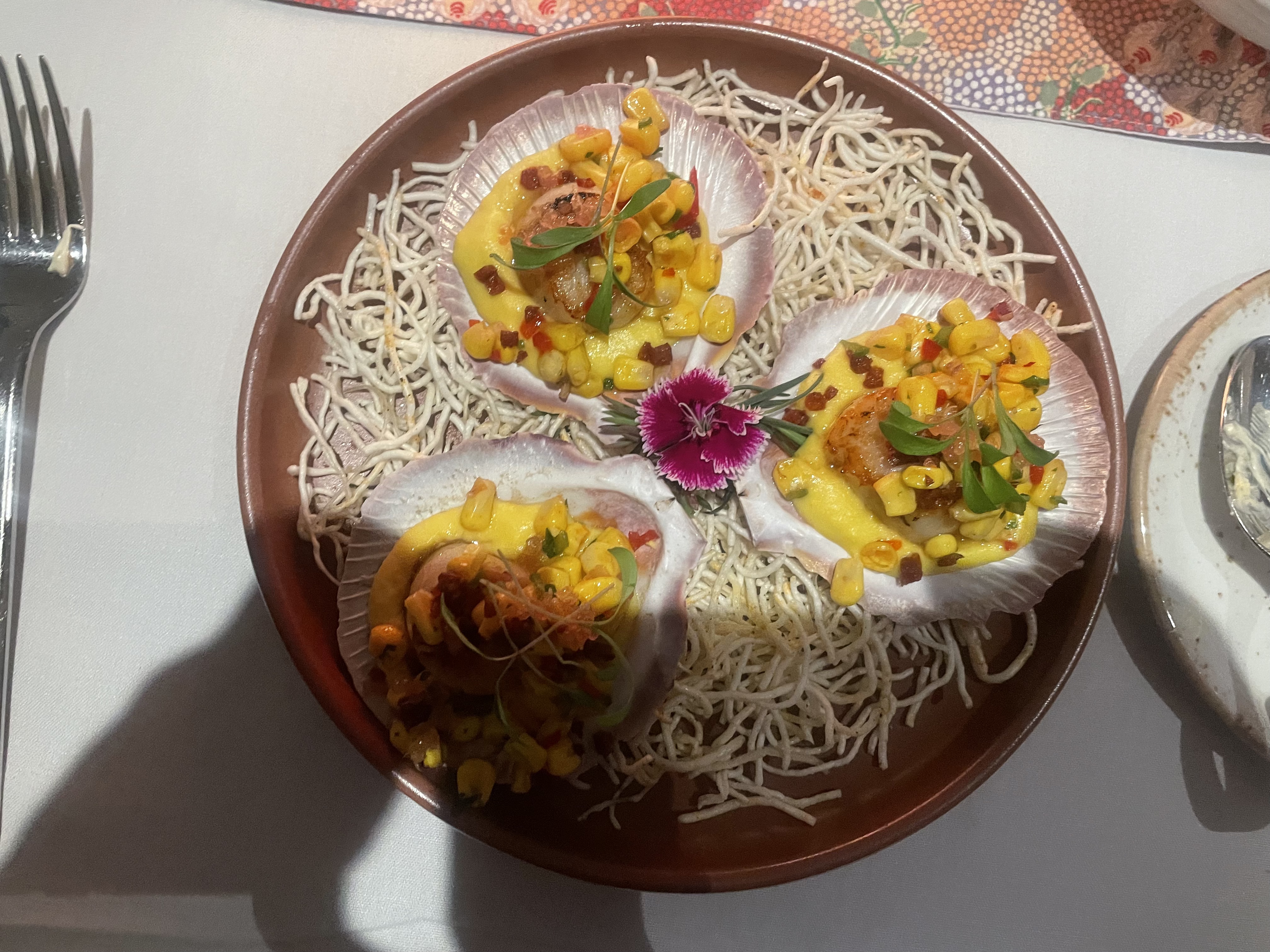
We had an exciting dinner and a special dessert in a nearby restaurant where five handsome Fijian waiters serenaded me, by name, with their take on the Happy Birthday song!


One of my five birthday song vocalists!


Scallop Ceviche


Lamb rack


Birthday platter


My five-day birthday celebration at Uluru in December 2022 was epic!  


To my awesome Aussie family who helped me remove Uluru from my bucket list, I say, 'palya', the aboriginal word for hello, goodbye, and thank you!


Sign outside the entrance to Ayers Rock/Connellan Airport


Rusting red sand . . .  


Ancient ceremonies in sacred monoliths  . . . 


Fly nets as essential fashion accessories   . . . 


I am NOT in Kansas!


PLEASE SIGN IN TO GOOGLE TO LEAVE A COMMENT!