Language Translator

Search This Blog

Showing posts with label Australiantourism. Show all posts

Monday, April 11, 2016

Aussie Money

The national currency in Australia is the Australian dollar.  The denominations are $100, $50, $20, and $10 notes. 


The 'one-hundred' is green, the 'fifty' gold - the 'twenty' red, the 'ten' blue, and the 'five' pink.  Each note pictures a famous Australian. 


The notes are made of a plastic polypropylene polymer and can't be torn intentionally or by normal wear and tear. 


And as a bonus - it's all waterproof!


The money is almost too pretty to spend, but with the current foreign exchange rate ($1.00 US = $71.36 AUS).   


That's like having a 25% off coupon for everything I buy anywhere in the country! 


I'm going shopping!

Exchange rates change, so check the exchange rates before booking your flight for a spending spree down-under.


Along with the Aussie dollar, the currency includes coins worth $1, $2, and 5, 10, 20, and 50 cents. 


The one-dollar coin is gold and similar to the quarter but heavier. 


Two-dollar coins are smaller than the one-dollar and slightly larger than a penny but three times as heavy.


The silver coins are sized proportionally to their value.  And, there are NO pennies Aussies got rid of them in the '60s.


You never pay extra for sales tax because it's already calculated in the merchandise price, so you only ever pay what's on the sales ticket. 


But if something costs $4.99 and you pay with a $5.00 note, don't expect a penny back. 


Counting money is the same, but you need to remember the Aussie coins look different than those in the US.


So, you can imagine my confusment when my bus fare was $2.40, and I gave the driver two gold coins and two twenty-cent coins, like below and he looked at me as if something was wrong.


I kept thinking that the $1 gold coin should be smaller than the $2 gold coin.

And finally realized I was giving him two $2.00 coins which added to $4.40 instead of $2.40.


To me, at first glance, they looked alike. 


Each time I overpaid, the driver smiled, gave me a $2 coin back, and asked, "Visiting?"


(Yeah, how did he know?)


Australia is a constitutional monarchy.  Its elected Head of Government is a Prime Minister who governs within a parliament, and the Queen of England is the sovereign who reigns but does not rule.


Her Majesty Queen Elizabeth II's official jeweler designed the currency, which is probably why the Queen is on the front of all Aussie coins, not to mention so pretty.


Australian dollars come in vivid colors, and to me, look like Monopoly money.  But be very careful, because it's not!


Queens . . .


Waterproof money . . .


No pennies . . .


I'm NOT in Kansas.


Thursday, April 7, 2016

Common Aussie Spiders

Have you ever seen anything like this curious-looking spider? 


It's a female poecilopachys Australasia, aka, ,two-spined spider found in Australia and New Zealand.


Two-spined spider.


This little fellow was in my co-mother-in-law's back garden.  


She lives around the corner from my daughter's house.  


It's a little bitty thing, only 5/16 of an inch, non-aggressive, and not harmful to people. 


It makes its little web at night and hides under a leaf during the day.


Yellow and white stripped two-spined spider.

Yellow and white two-spined spider.

Video of a two-spined spider crawling.  
The background noise is of squawking cockatoos.


Spiders do not construct webs haphazardly, nor do they catch them by luck; they have a design sense that attracts predators.


Beautiful backyard spider web wet with dew.


Spider season in Sydney begins in September. 


During this time of year, orb-weaving spiders take over the back gardens with very tough webs that stretch securely over vast areas.  


Spiders start with a single sticky thread that they release to the wind to weave their intricate webs. 


When it attaches to an object securely, the spider begins weaving using non-sticky silk. 


They walk around till it's entirely constructed before laying down sticky spiral silk.


Web without spider.

Large scaled web in the back gardens.


Web without a spider.


Older web in the back garden.


Spider web, probably constructed by an Orb Weaving spider.


I've seen many impressive webs that appear to be void of spiders in Sydney; however, that doesn't mean that they aren't spiders nearby.


Some spiders lie in wait, hiding from predators by wrapping themselves in leaves or sitting slightly away from the web on a branch.  


But not all spiders hide!


The St. Andrew's Cross sits boldly with its legs in pairs, in plain sight, day and night.


They are supposed to resemble St. Andrews' crucifixion, a martyr who died on a cross in the shape of an X.


At only 1/8 inch long, the spider spins a medium-sized web and decorates it using a silk structure that resembles ribbon, or a zig-zag, called stabilimentum.


The ribbon attracts ultraviolet light, which flying insects like, and the stabilimentum web decoration throws off predators who may not realize it's a spider web. 


Birds avoid decorated webs because experience has taught them that it's tough to get spider silk out of plumage if they fly into them.


Stabilimentum - zig-zag web decoration.

As a scare tactic, the St. Andrews Cross spider will shake the web to confuse and disorientate predators making it easy to pick them off. 


These spiders are not aggressive, nor or they dangerous to people.   


I've seen the Cross on the back of chairs, low railings, and in between bushes in the front garden. 


One seems to live above the Frangipani plant on the front porch because it's always there sitting upside down in the middle of their web, forming an X cross. 


It is uncommon for this spider to enter homes, but haha, unlucky me, it looks like this one got inside.


St. Andrews Cross (pretty sure).


Golden Orb-weavers spiders place their webs pretty high up.  They are non-aggressive and nontoxic arachnids.


They have shiny bodies and long skinny legs with gold bands. 


At 17 inches, the Golden Orb-weaver is one of Australia's biggest spiders. 


They are known for spinning webs between trees and hanging out with their partner.


How sweet!


While their bite's toxicity to humans is similar to a bee sting, it can subdue an animal.


While walking, I came across an impressive female Coastal Golden Orb-Weaver spider.


Although it was very high up, its web caught my attention because it was three-dimensional, making me think that the spider had constructed a three-bedroom spider web!


Its bite is nontoxic but could cause progressive ulceration and loss of skin around the bite site.


The Garden Orb Weaver is another common Aussie spider.  


This one is big, hairy, heavy-bodied, and scary-looking. 


A bite from it may cause mild pain and redness, but it is not toxic - again - similar to a bee sting.


Busy workers, a new web is constructed each night utilizing the same space. 


It's like they remember what matters when weaving a web: location, location, location. 


In the back garden, there are plenty of trees to anchor webs. 


Some mornings I've woken to more webs than I wanted to count.


Each spider species is unique!  


The Garden Orb Weaving spider works through the night to construct a wheel-shaped web.  


When an insect gets stuck, the spider senses vibrations on the web, grabs the prey, wraps it up in silk, and hangs it on the web for later. 


This reddish-brown spider or grey has a triangular-shaped body and a leaf pattern on its back.


They are not aggressive and not prone to bitting; however, if threatened, they will bite, resulting in mild pain, possibly nausea, and dizziness.


Fortunately for me, most of the webs in the yard are high enough to walk under, but I've accidentally walked through enough of them to know it's the worse feeling.  


I've heard that if you walk into one, walking backward out of it is the way to go, but I doubt that would stop me from the knee-jerk reaction of frantically trying to wipe it off.


So, to eliminate the problem, I use my nifty spider stick to move them out of my way.  


My Aussie family disapproved of my tearing down webs at first, but when a large one was blocking the entrance to the front door, my son-in-law yelled out, "Get your stick!"


Australians believe in living in harmony with wildlife which I get, but I'm teaching my grandson how to use my stick!


I find it interesting that all spiders do not weave webs, like the infamous Huntsman spider. 


As their name suggests, this spider stalks then pounces on its prey. 


They are speedy and able to run it down. 


Seeing a Huntsman inside the house in Sydney is expected.  


As big as they are, legs span 5 inches; they flatten their bodies like pancakes to get under doors and windowsills. 


Huntsman spider outside the window pane.


Huntsman spider on the window pane.


It's nontoxic and cautious of people, so I'm not sure why it wants to get inside the house.  


Out of all the spiders I've seen, nothing freaks me out as much as seeing this one crawling up a wall.


While it's true that the most dangerous spiders in the world live in Australia, like the redback, funnel-web, trap door, mouse, white-tailed, recluse, and tarantula, that doesn't necessarily mean you'll see any of these dangerous critters while visiting.   


All of the spiders I've seen are all in this post.


However, that said, if threatened, big or small, toxic or not, all spiders bite just a little.


Spider with horns . . .

Spiders with massive webs . . .

Spiders without webs . . .


I am NOT in Kansas!


Wednesday, April 6, 2016

Leeches

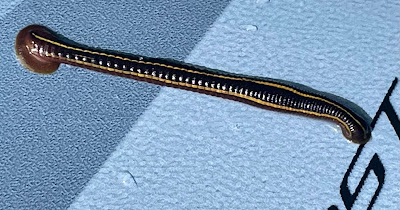
There are over 100 species of leeches in Sydney.  Not all of them are bloodsucking, but the ones around our house are. 


They're carnivorous segmented worms with powerful suckers at each of their ends.  


The rear one helps the leech move around, and the front is for holding on to feed after latching onto a host. 


My grandson, Jethro, had just gotten a new floaty for the backyard pool.  


He hopped in it with his arms hanging out when he noticed the leech reaching for his warm body. 


Luckily, he saw it headed toward him and got out of the floaty before the leech reached him.


Australian leech.


Jethro's new floaty.

A leeches' size and shape will vary from 7 mm (0.27 inches) to 300 mm (11.8 inches).


They dwell near bodies of water, but because of suburban sprawl, warm weather, and hard rains, they are in Sydney's gardens, decks, and homes like mine.


These parasites have a simple technique when looking for food.  


They slither, wave, and stretch their bodies until they connect with something warm-blooded.


Just watching them makes me shiver!


After connecting with a host and latching on, it releases mucus, saliva, and an anticoagulant enzyme that allows blood to flow for a long time without clotting. 


The antiseptic in the saliva eases the pain at the bite site.  


Their receptors can detect a blood meal by smell, sight, temperature, and vibration. 


They can also sense carbon dioxide, so don't move or exhale! 


My first experience with a leech was when I sat on a low step on my deck floor and touched it with my fingertip.


When I noticed it, I thought it was a worm, but it was hanging on - not a worm characteristic. 


I tried shaking it off, but that didn't work, so I quickly rubbed my finger against a nearby table until it dropped off. 


I didn't know at the time, but there is a proper way to remove a leech.


Pulling off a leech could cause it to vomit blood into the wound, which could lead to an infection, so it's better to let it drink its fill and fall off on its own.


Leeches must have blood to grow and reproduce. The small one I smashed against the deck was all blood. 


Blood splatter from a leech I smashed!


A leech surprised me in my kitchen while washing dishes - I didn't see it lying in the silverware drawer.


They are sneaky, but so am I. 


Salt causes these bloodsuckers to lose moisture and disintegrate!  


So, I poured some on it while it moved among the forks. 


It dried up instantly. 


However, only salt a leech if it is on a surface, not your skin!


Luckily, these parasites don't drop down on people, nor do they bury themselves into the skin or leave pieces of them (like their head) in a bite site.


Coincidently while writing this post, it was raining, and my daughter spotted one coming up through the floorboards carrying a ball of dust.  


I think the itsy bitsy spider song playing in the background is kind of appropriate.


My co-mother-in-law found a leech slithering around on her carpet.  


As a result, I don't walk barefoot indoors or outside in Sydney.


Leech on a carpet.

We noticed a leech on a shirt, trying to get under it to feed. 


Fortunately, we could grab the shirt and use the leech for a photoshoot before it used us as a meal.


There is no evidence suggesting they transmit any diseases, but there will be blood and itching if bitten.  


Leech bite.

Leech bite.

Allergies to bites have been reported and treated with an antihistamine and Epipen.


I'm happy to report that I haven't experienced any allergic reactions, even after coming into contact with several leeches. 


Although creepy, they aren't harmful or dangerous. 


And yes, they're gross but essential. 


Being both predator and prey, they help the river and bush ecosystem stay in balance. 


Medically, the enzymes they release can relieve patients during surgery by reducing swelling and stopping clotting when needed during a surgical procedure.


For this reason, medicinal leeches, found in Europe and Western Asia, are protected insects, but all of the rest are fair game!  


So please, pass the salt!


Leeches in the garden . . .


Leeches on my deck . . .


Leeches inside the house . . .


I am NOT in Kansas!


Harbour Loop to the Emerald City

My blog cover picture is of the Sydney Harbour with Kirribilli, a cozy suburb nestled in the background. 


My daughter lived there for more than ten years before moving north of the harbor.


The ferry is a popular mode of transportation (public transport) for folks lucky (and wealthy) enough to live on the harbor.


My son-in-law and many professionals rode it to the City (or Central Business District) to go to work.


The ferry stop was 400 meters from our apartment - a 4-minute walk. It was usually on schedule, every 20 minutes during rush hour. 


I always arrive early to enjoy the harbor's rocking motion of the ferry and fantastic views. 


The ride into the city takes me past international icons like the Sydney Opera House. 


From the water, you get a magnificent view of Oz.


The white roofs on the Opera House are shaped like sails on a sailboat by design.  


The harbor draws thousands to the water for recreation, competitions, and panoramic views of the infamous landmarks each year.


A close-up of the Opera House roofs shows it resembles seashells.


The glass front of the Opera House provides a beautiful view of the harbor from inside the auditorium. 


It's not just a pretty face. 


It features great artists from all over the world. 


Across from the Opera House is the famous Sydney Harbour Bridge.


The bridge plays center stage each year as Sydney is one of the first cities to kick off the world's New Year's Eve celebrations! 


Fireworks explode from the top of the bridge and flow from it like a waterfall.


If you want a thrill, try booking a climb to the top of the bridge. 

Yes, I mean the very top where the flags are flying. 


To be eligible to climb, you need proof of fitness, a blood-alcohol reading below .05, and over eight years of age. 


Also, if you are over 24 weeks pregnant, forget about it!


It takes more than nerve to climb cause it isn't cheap.

  • Children = $100-200 AU 
  • Adults = $300 - 400, AU

Check it out at Bridgeclimb.  It will blow your mind!    


Oprah and Gail did it when she came to town. 


As my ferry steers closer to the dock, a cruise ship appears.


Harbour City Ferries operates a fleet of 28 boats with inside & outside seating, restrooms, water fountains, and sea breezes.  


This ferry takes me to Circular Quay (pronounced Kee), the ferry hub.   


I am in la-la land off the ferry, where the energy and activity are through the roof. 


Excited tourists and locals are taking in the sights - snacking, dining, shopping, and snapping selfies and pictures of one another. 


Street musicians (Buskers) and magicians are entertaining the crowd, all there for your pleasure and enjoyment (= tip). 


Aboriginal musicians are playing the didgeridoo. 


Sistahs, this is a great place to get a husband! 


Some folks are waiting on ferries, and others, are just having a look, a coffee, or a beer.


I'm hanging out around Whaf 5 - there are 6 of them in total. 


Learn more at Sydney Ferries.


Circular Quay is active all year long, and the shops and restaurants play to the diversity of the tourists. 


UGG shops are everywhere. 


Koala and Kangaroo stuffed animals are everywhere on sale. 


Australian meat pies, authentic Chinese, and even American fast foods are in Circular Quay.


Hungry Jacks is Australia's, Burger King.


A short walk around will take you to the steps of Botanical Gardens, where you can see beautifully manicured gardens, exotic trees, and tropical native birds, or to the Sydney Opera House.


Life is good on the Sydney harbor!


Sydney Opera House . . . 


Ferrying to work . . .


Aboriginal buskers . . . 


I'm NOT in Kansas.