After a week of rain, I was taking out the trash when I saw a translucent weird-looking bug with a red geometric design on its back that hardly looked real.
I thought, 'What in the world?'
I went immediately into survival mode and quickly ran back inside the house - still carrying trash.
I asked my son-in-law to go out and take a look at the bug.
Returning inside, he asked, "How'd you like that slug?"
Piqued with curiosity, I went back out to take another look after getting up the nerve.
Snapping a picture, I grabbed my computer and looked it up on Google Images.
The critter was a typical Sydney garden-variety slug called the red triangle slug - common in eastern Australia.
I thought, 'Now that's a slug of a different color!'
It's also known as a leaf-vein slug because the thin lines on its back resemble a leaf.
Thankfully, it doesn't bite and is not poisonous, but some carry parasites.
Not sure how you know which ones.
It has two tentacles, a red border, and quite a dramatic hole in the center of the triangle, which is its yucky-looking breathing spore.
It reminded me of that old expression about putting lipstick on a pig.
One day unexpectedly, I came across another land slug with a grey body and orange triangle, blending in with the wet cement wall.
That's when I found out that these critters vary in color and can be white, grey, beige, red, pink, or olive green.
I decided to measure it to get a sense of its size.
This one was probably young at three inches since they can grow to be eleven.
Like most slugs, it moved slowly, making it an easy target to photograph.
But for its predators, they are a challenge to catch.
When threatened, it secretes a sticky defense mucus as powerful as super glue that can stick an animal, as large as afrog, to a surface for hours - giving the slug time to crawl away slowly.
However, it's a mystery how the slug itself doesn't get stuck in its glue.
Birds find it difficult to grab hold of them because they are slimy.
You've got to love nature!
Red triangle slugs are nocturnal and keep out of sight during the day, which may be why I hadn't seen one before.
While they are not rare in Sydney, they can be hard to find if searching for one.
Many unusual critters found in the back garden come from the remnant bushland close to the house calledEcho Point Park,where there are many places for them to hide during the day, like under leaf debris, broken branches, and aggregate stones.
They are known to graze on lichen and algae from the Eucalyptus trees and leave recognizable trailswhere they have cleared paths.
After a heavy rain, they crawl up stone walls and over rocks looking for lichen or mosses.
So don't pull out the salt shaker if you find this critter inside the house.
Instead, please put it in your bathroom, where it will remove all the mold from your tile, floor, cracks, shower, and shower curtains!
They're supposedly better than the harsh cleaners you find in big box hardware stores and biologically friendly to boot!
Now that's what I'm talking about!
However, keep in mind that they may want a house tour after removing bathroom mold.
If you're like me, you probably don't like slimy slow-crawling creatures like slugs, worms, or leeches, but you have to admit, the red triangle slug is quite a spectacle!
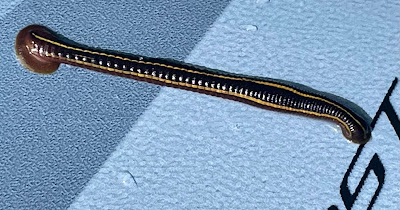
There are over 100 species of leeches in Sydney. Not all of them are bloodsucking, but the ones around our house are.
They're carnivorous segmented worms with powerful suckers at each of their ends.
The rear one helps the leech move around, and the front is for holding on to feed after latching onto a host.
My grandson, Jethro, had just gotten a new floaty for the backyard pool.
He hopped in it with his arms hanging out when he noticed the leech reaching for his warm body.
Luckily, he saw it headed toward him and got out of the floaty before the leech reached him.
Australian leech.
Jethro's new floaty.
A leeches' size and shape will vary from 7 mm (0.27 inches) to 300 mm (11.8 inches).
They dwell near bodies of water, but because of suburban sprawl, warm weather, and hard rains, they are in Sydney's gardens, decks, and homes like mine.
These parasites have a simple technique when looking for food.
They slither, wave, and stretch their bodies until they connect with something warm-blooded.
Just watching them makes me shiver!
After connecting with a host and latching on, it releases mucus, saliva, and an anticoagulant enzyme that allows blood to flow for a long time without clotting.
The antiseptic in the saliva eases the pain at the bite site.
Their receptors can detect a blood meal by smell, sight, temperature, and vibration.
They can also sense carbon dioxide, so don't move or exhale!
My first experience with a leech was when I sat on a low step on my deck floor and touched it with my fingertip.
When I noticed it, I thought it was a worm, but it was hanging on - not a worm characteristic.
I tried shaking it off, but that didn't work, so I quickly rubbed my finger against a nearby table until it dropped off.
I didn't know at the time, but there is a proper way toremove a leech.
Pulling off a leech could cause it to vomit blood into the wound, which could lead to an infection, so it's better to let it drink its fill and fall off on its own.
Leeches must have blood to grow and reproduce. The small one I smashed against the deck was all blood.
Blood splatter from a leech I smashed!
A leech surprised me in my kitchen while washing dishes - I didn't see it lying in the silverware drawer.
They are sneaky, but so am I.
Salt causes these bloodsuckers to lose moisture and disintegrate!
So, I poured some on it while it moved among the forks.
It dried up instantly.
However, only salt a leech if it is on a surface, not your skin!
Luckily, these parasites don't drop down on people, nor do they bury themselves into the skin or leave pieces of them (like their head) in a bite site.
Coincidently while writing this post, it was raining, and my daughter spotted one coming up through the floorboards carrying a ball of dust.
I think the itsy bitsy spider song playing in the background is kind of appropriate.
My co-mother-in-law found a leech slithering around on her carpet.
As a result, I don't walk barefoot indoors or outside in Sydney.
Leech on a carpet.
We noticed a leech on a shirt, trying to get under it to feed.
Fortunately, we could grab the shirt and use the leech for a photoshoot before it used us as a meal.
There is no evidence suggesting they transmit any diseases, but there will be blood and itching if bitten.
Leech bite.
Leech bite.
Allergies to bites have been reported and treated with an antihistamine and Epipen.
I'm happy to report that I haven't experienced any allergic reactions, even after coming into contact with several leeches.
Although creepy, they aren't harmful or dangerous.
And yes, they're gross but essential.
Being both predator and prey, they help the river and bush ecosystem stay in balance.
Medically, the enzymes they release can relieve patients during surgery by reducing swelling and stopping clotting when needed during a surgical procedure.
For this reason, medicinal leeches, found in Europe and Western Asia, are protected insects, but all of the rest are fair game!
The first birds that caught my eye in Sydney were the iconic sulphur-crested cockatoos - backyard birds native to Australia, Indonesia, and New Guinea.
They are massive birds that grow to be 17 inches.
They have beautiful white plumage, stunning black eyes, and well-kept beaks that they trim by chewing on small tree branches.
Sulphur-crested cockatoo.
Cockatoos are exotic birds with a recognizable yellow crest, which they use to communicate and express emotions.
They raise their crest when they are excited or curious and fluff it after preening.
Fun and funny, cockatoos are known to bob their heads when they want something or to the tune of a good song.
Lowering their crest is a sign that all is well.
These birds are as loud as they are beautiful!
While bird alarm sounds, like screeching or squawking, are an excellent tactic to warn the flock of an approaching predator, it is not pleasant to hear when sitting in the back garden enjoying a peaceful cup of coffee.
I was so excited when a cockatoo landed on the back deck railing.
I wanted to feed it, but my daughter warned me not to cause many more would come.
Not listening, I fed it anyway, and more came.
Cockatoo eating crumbs off the deck.
Cockatoos perched on the railing.
Cockatoos are not mean birds but can be aggressive and lunge toward you if they feel fear or stress.
You can see the yellow wash on the inside of their wings when they flutter. This action can be pretty startling if you're nearby.
Jethro and the fluttering cockatoos.
Before the cockatoos came, I was excited about a tomato plant on the deck with two tomatoes on the vine ripening, and my son-in-law was thrilled with his new herb garden in the 3-tier deck planter.
The tomatoes, plants, leaves, and herbs were gone when the birds left!
So we had to plant flowers. Bummer!
Deck planter with flowers.
The birds continue to visit from time to time, hoping to find something to eat.
They are out of luck at my house.
It was time for them to find a new food source cause I stopped feeding them - daughter knows best!
While tourists, like me, love to look at them, most Aussies call them pests.
They can be destructive in large flocks because they like to chew on wood, decks, and outdoor furniture, not to mention the poop they drop every 15 minutes.
A healthy cockatoo diet consists of blossoms, berries, nuts, fruit, vegetation, and leaf buds, along with two ripe tomatoes and a few herbs.
To protect fruit trees from cockatoos, Sydneysiders cover them with fruit netting.
Densely woven mesh netting protects animals from becoming trapped or injured.
It's not a nice look in the front garden, but it's worth it for a harvest of fresh fruit!
Lemon tree
Lemon tree.
Mango tree.
Mango tree.
Orange tree.
Even though cockatoos are noisy and pesty, we still get a kick out of seeing them up close and personal.
There are twenty-one different species of cockatoos; five of them are native to Sydney.
I didn't realize this until I came across a family of pink & grey cockatoos —feeding off the seeds and vegetation in a nearby field.
These exotic birds are called rose-breasted cockatoos.
They have grey wings, feet, tail feathers, and pink underparts covering their face, breast, and belly.
The aboriginal name for them is "galah," which means silly or loud.
Although "galahs" are supposed to be one of the most common cockatoos in eastern Australia, this was my first encounter.
They enjoy open areas and are supposed to be very friendly to humans, although they wouldn't let me get close enough for a proper photoshoot.
Rose-breasted cockatoos.
Rose-breasted cockatoos take flight.
Finding the rose-breasted cockatoos was a serendipitous encounter, and it put me on a quest to find other species.
When visiting another country, taking pictures of birds is one of those things I do.
After all, I'm just an American tourist with time on my hands and a decent Phone camera!