Language Translator

Search This Blog

Showing posts sorted by relevance for query common spiders. Sort by date Show all posts

Thursday, April 7, 2016

Common Aussie Spiders

Have you ever seen anything like this curious-looking spider? 


It's a female poecilopachys Australasia, aka, ,two-spined spider found in Australia and New Zealand.


Two-spined spider.


This little fellow was in my co-mother-in-law's back garden.  


She lives around the corner from my daughter's house.  


It's a little bitty thing, only 5/16 of an inch, non-aggressive, and not harmful to people. 


It makes its little web at night and hides under a leaf during the day.


Yellow and white stripped two-spined spider.

Yellow and white two-spined spider.

Video of a two-spined spider crawling.  
The background noise is of squawking cockatoos.


Spiders do not construct webs haphazardly, nor do they catch them by luck; they have a design sense that attracts predators.


Beautiful backyard spider web wet with dew.


Spider season in Sydney begins in September. 


During this time of year, orb-weaving spiders take over the back gardens with very tough webs that stretch securely over vast areas.  


Spiders start with a single sticky thread that they release to the wind to weave their intricate webs. 


When it attaches to an object securely, the spider begins weaving using non-sticky silk. 


They walk around till it's entirely constructed before laying down sticky spiral silk.


Web without spider.

Large scaled web in the back gardens.


Web without a spider.


Older web in the back garden.


Spider web, probably constructed by an Orb Weaving spider.


I've seen many impressive webs that appear to be void of spiders in Sydney; however, that doesn't mean that they aren't spiders nearby.


Some spiders lie in wait, hiding from predators by wrapping themselves in leaves or sitting slightly away from the web on a branch.  


But not all spiders hide!


The St. Andrew's Cross sits boldly with its legs in pairs, in plain sight, day and night.


They are supposed to resemble St. Andrews' crucifixion, a martyr who died on a cross in the shape of an X.


At only 1/8 inch long, the spider spins a medium-sized web and decorates it using a silk structure that resembles ribbon, or a zig-zag, called stabilimentum.


The ribbon attracts ultraviolet light, which flying insects like, and the stabilimentum web decoration throws off predators who may not realize it's a spider web. 


Birds avoid decorated webs because experience has taught them that it's tough to get spider silk out of plumage if they fly into them.


Stabilimentum - zig-zag web decoration.

As a scare tactic, the St. Andrews Cross spider will shake the web to confuse and disorientate predators making it easy to pick them off. 


These spiders are not aggressive, nor or they dangerous to people.   


I've seen the Cross on the back of chairs, low railings, and in between bushes in the front garden. 


One seems to live above the Frangipani plant on the front porch because it's always there sitting upside down in the middle of their web, forming an X cross. 


It is uncommon for this spider to enter homes, but haha, unlucky me, it looks like this one got inside.


St. Andrews Cross (pretty sure).


Golden Orb-weavers spiders place their webs pretty high up.  They are non-aggressive and nontoxic arachnids.


They have shiny bodies and long skinny legs with gold bands. 


At 17 inches, the Golden Orb-weaver is one of Australia's biggest spiders. 


They are known for spinning webs between trees and hanging out with their partner.


How sweet!


While their bite's toxicity to humans is similar to a bee sting, it can subdue an animal.


While walking, I came across an impressive female Coastal Golden Orb-Weaver spider.


Although it was very high up, its web caught my attention because it was three-dimensional, making me think that the spider had constructed a three-bedroom spider web!


Its bite is nontoxic but could cause progressive ulceration and loss of skin around the bite site.


The Garden Orb Weaver is another common Aussie spider.  


This one is big, hairy, heavy-bodied, and scary-looking. 


A bite from it may cause mild pain and redness, but it is not toxic - again - similar to a bee sting.


Busy workers, a new web is constructed each night utilizing the same space. 


It's like they remember what matters when weaving a web: location, location, location. 


In the back garden, there are plenty of trees to anchor webs. 


Some mornings I've woken to more webs than I wanted to count.


Each spider species is unique!  


The Garden Orb Weaving spider works through the night to construct a wheel-shaped web.  


When an insect gets stuck, the spider senses vibrations on the web, grabs the prey, wraps it up in silk, and hangs it on the web for later. 


This reddish-brown spider or grey has a triangular-shaped body and a leaf pattern on its back.


They are not aggressive and not prone to bitting; however, if threatened, they will bite, resulting in mild pain, possibly nausea, and dizziness.


Fortunately for me, most of the webs in the yard are high enough to walk under, but I've accidentally walked through enough of them to know it's the worse feeling.  


I've heard that if you walk into one, walking backward out of it is the way to go, but I doubt that would stop me from the knee-jerk reaction of frantically trying to wipe it off.


So, to eliminate the problem, I use my nifty spider stick to move them out of my way.  


My Aussie family disapproved of my tearing down webs at first, but when a large one was blocking the entrance to the front door, my son-in-law yelled out, "Get your stick!"


Australians believe in living in harmony with wildlife which I get, but I'm teaching my grandson how to use my stick!


I find it interesting that all spiders do not weave webs, like the infamous Huntsman spider


As their name suggests, this spider stalks then pounces on its prey. 


They are speedy and able to run it down. 


Seeing a Huntsman inside the house in Sydney is expected.  


As big as they are, legs span 5 inches; they flatten their bodies like pancakes to get under doors and windowsills. 


Huntsman spider outside the window pane.


Huntsman spider on the window pane.


It's nontoxic and cautious of people, so I'm not sure why it wants to get inside the house.  


Out of all the spiders I've seen, nothing freaks me out as much as seeing this one crawling up a wall.


While it's true that the most dangerous spiders in the world live in Australia, like the redback, funnel-web, trap door, mouse, white-tailed, recluse, and tarantula, that doesn't necessarily mean you'll see any of these dangerous critters while visiting.   


All of the spiders I've seen are all in this post.


However, that said, if threatened, big or small, toxic or not, all spiders bite just a little.


Spider with horns . . .

Spiders with massive webs . . .

Spiders without webs . . .


I am NOT in Kansas!


Friday, November 2, 2018

Huntsman Spider

It's a well-known fact that Australia is infamous for its spiders, and with good reason. 


They're pretty scary looking, have shiny hairy bodies and eight legs!


Unless trapped behind a glass enclosure, even fearless Aussie children, like my grandson, is a bit leery of them.


I hadn't intended on capturing a Huntsman spider on this day. 


But if you read many of my posts, you know that I just let life happen when I'm in Sydney, and something astonishing usually does.


Grandson looks at a Huntsman with suspicion.    


It was a warm Spring afternoon, and our doors were wide-open. 


For some reason, Aussie homes don't have screen doors, which I don't understand since this is Australia. 


I would want screens around everything!


While walking past the open doorway, I noticed a Huntsman spider on the top of the roller blind.  


I've developed a special knack for spotting critters I don't want to see.  


I knew a Huntsman spider flattens its body to get under doors and windowsills, and because our door is near a window, I was able to figure this one out.


Door open - no screens!


I surprised myself and didn't panic . . . this time. 

After all, this was not my first dance with a Huntsman. 

Once I woke up in the middle of the night to discover one getting ready to crawl up the wall.  

I didn't sleep at all that night!


Huntsman spider with dust on its legs.


Another time I noticed one through the window that appeared to be trying to make its way to the window pane. 

Huntsman spider outside the window.


Huntsman spider on the window.

It's comforting to know that they are non-aggressive unless provoked, and I wasn't about to do that!  

Besides, I've never actually heard of them crawling or dropping down on people - my worse fear!

They have venom, but it's considered low-risk, nontoxic to humans.
 

A bite may cause swelling and minor pain, and an ice pack and a topical anesthetic are all that is needed to treat it.


To avoid the unnecessary stress of dealing with the spider myself, I quickly texted my daughter, who was on her way home from work, to ask her to hurry!

Then, I sat patiently staring at it -  willing it not to move till she came home.


A flattened Huntsman spider.


She arrived within minutes, rushed in, and asked where it was. 


Lucky for me, she's a real Huntsman spider trapper!


I was happy to point out its location. 


She pulled the shade down a bit, startling the critter, and it was on the move.    


Huntsman spider crawling down the blind.

Without blinking an eye, she placed a water glass over it, abruptly stopping its descent, slid a piece of cardboard underneath, and captured it in a matter of moments.  


What a pro!


Huntsman spider - captured in a water glass.

The Huntsman is a massive brown hairy spider with a one-inch flat body and eight legs banded and twisted, enabling it to spread them to advance forward and sideways in a crab-like fashion. 


They are often are called crab spiders.  


They molt to grow, and their old skin can be mistaken for the actual spider. 


When they are not inside, they live under loose tree bark and in rock crevices and feed on insects and other invertebrates like mosquitos, cockroaches, and sometimes geckos and small skinks. 


They come inside to grab a couple of common household insects and to escape Sydney's hot summer weather.


Some Aussies like to keep them as housemates because of their passive temperaments and appetite for household pests like roaches - not happening here!


Just looking at them makes me squeamish!


Huntsman spider crawling up our wall.

As their name suggests, they are true hunters.


They do not construct webs to catch prey.


Instead, they stalk their target, run it down, then pounce.


Like all spiders, they are nocturnal and can get into cars at night, so be sure to close car windows and doors.


They hide behind sun visors and steering wheels and scuttle out, startling drivers going 50 miles an hour on the freeway. 


Knee-jerk reactions have caused car crashes.


The mere sight of this enormous spider is the stuff of nightmares, and the movie industry made it the star of their 1990 horror-comedy thriller Arachnophobia.


Named after the debilitating fear of spiders and other multi-legged creatures, many people have Arachnophobia, and many more are just plain afraid of spiders and don't know why. 


These eight-legged critters just freak us out!


While filming the movie, the Landcare Research organization in Auckland flew three hundred Australian Huntsman spiders to the set every two weeks. 


They were selected because they're scary-looking yet nontoxic and relatively harmless. 


Fortunately, unlike the movie, only one comes in the house at a time. 


The Movie


There are 1,207 species of the huntsman spider in the family Sparassidae, and 155 of them are in Australia.


Spider experts have identified 4,000 other species, with another 8,000 more still a mystery. 


Aussies love their native animals and critters - harming them is never an option. 


They believe that the huntsman spider deserves a place alongside koalas and kangaroos and, therefore, should be treasured. 


So my daughter took it outside to set it free in a nearby bush  - which is the recommended way to remove spiders from the house.


If you swat a pregnant spider,  it could release 200 spiderlings before dying.  


The redback, funnel-web, trap door, mouse, white-tailed, recluse, and tarantula spiders are dangerous and deadly, and if one of those had gotten in the house, this would have been a very different story.


Infamous Huntsman spiders . . . 

Spiders that crawl under doors . . . 

Spiders that hide in cars . . . 


I am NOT in Kansas!

Saturday, May 18, 2024

"Australian Laughing Kookaburra"

Australian Laughing Kookaburra

A few summers ago in Sydney, I was standing in my co-grandmother's beautiful back garden, eating a sausage sandwich and admiring her breathtaking view, when a Kookaburra swooped down, grabbed the sandwich out of my hand, and flew away!  

It happened so fast that I had no time to react, so I just stood there flabbergasted!
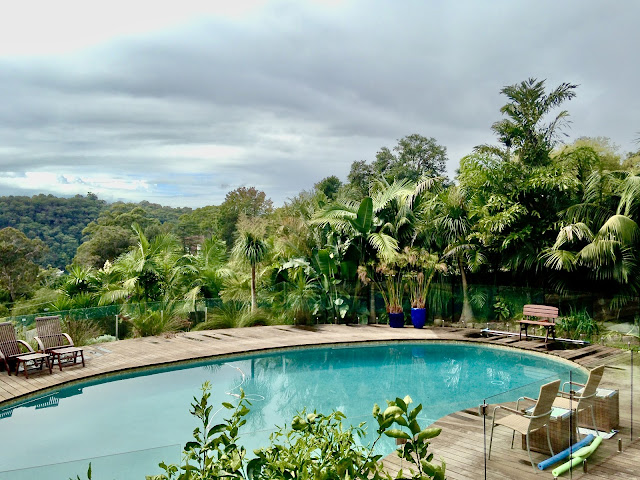
Photo of my co-grandmother's beautiful back garden and pool.

The Kookaburra is a big bird, 18 inches long from beak to tail, and it’s the largest in the kingfisher family.

They can be aggressive when hunting or cornered but laid-back and very comfortable with people who pose no threat, so I was never in danger from a bird attack. 

My sandwich, though, was an entirely different matter.
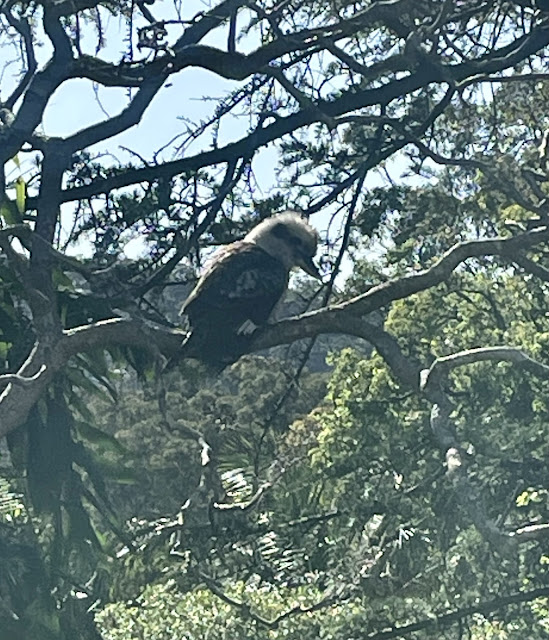
A Kookaburra, calculating where it will swoop next!

These birds are exclusively carnivorous (meat-eaters) and will grab meat right off the grill while cooking.

Their heavy beaks work like tweezers, making stealing food easy.  

Even though they are kingfishers, they eat more insects, spiders, frogs, reptiles, snakes, birds, rodents, etc., than fish.  

However, they occasionally snatch goldfish out of backyard aquatic ponds.

My daughter, proficient in DIY, designed and dug out her natural backyard pond. She has Kookaburras in her garden, so she bought a crocodile head to warn Kookaburras to stay away!    

A crocodile head will deter a Kookaburra!


Native to Australia, the Kookaburra is one of the country's most identifiable birds. I've spotted them perched in low and high places everywhere in Sydney. 

My son-in-law's favorite place to nap is on the front garden hammock, although he may not want to rest there with the Kookaburra. 

The colors in the bird's plumage complement each other. Its back is a stunning brown, and on each wing is a striking patch of blue. Its chest is creamy white, and its tail is reddish-brown with white feathers on the tips.

This photo shows the bird's beautiful color harmony!

A Kookaburra, spreading its wings!

It's a stocky bird with a thick neck, a buff-colored beak shaped like a boat, and a distinctive brown strip that crosses both eyes like a mask.

They are intelligent birds and can remember people's faces, which makes me wonder if this clever fellow will remember I was the sucker eating the sausage sandwich.   

The creamy chest of the Kookaburra pops against the blue Aussie sky.

The Kookaburra captured my attention again while I was vacationing with my family in a houseboat on the Hawkesbury River just outside Sydney.

Our beautiful weekend houseboat included a full kitchen, barbecue, fishing rods, bedrooms, a bathroom, a large upper deck, and lower decks wrapped around the boat.

Our beautiful houseboat!

To avoid running aground, we used dinghies to explore river areas too narrow or shallow for the houseboat. 

We would take the dinghy to get off the boat, dock it on the river's edge, and enjoy some Hawkesbury land tourist activities and shops. 

Dinghy

It was very dark on our first night on the water, and with no light coming from other sources, the night sky was majestic! 

Because Australia is in the Southern and Eastern Hemispheres, its galactic and intergalactic objects in space differ from those in the U.S. because the states are in the Northern and Western Hemispheres.

The brightest stars in the galaxy, like Sirius and Canopus, are in the Southern Hemisphere.

The commonly known Southern Cross constellation, which can also be seen from Australia, is depicted on the country's national flag.  


The Australian National Flag: The star that stands alone on the left has 6 points, each denoting the six states of Australia. The remaining five stars on the right represent the star constellation of the Southern Cross. 


Looking up from the top deck of the houseboat, I had never seen so many lights.  

I was mesmerized by the starry night sky when the sound of a crying baby from a distance diverted my attention.

The crying quickly changed into a chorus of screeches, whirring, and cackles resembling the sound of a troop of chimpanzees in the deepest part of a jungle. 

Right then and there, I knew what I knew: I was not in the U.S., and that was no crying baby!


Listen to the Kookaburra Cackle!

Credit - Kookaburra Sound'Supplied, courtesy of NSW Dept of Climate Change, Energy, the Environment and Water.  (https://www.environment.nsw.gov.au/topics/animals-and-plants/native-animals/native-animal-facts/laughing-kookaburra)

Credit - Photo: Sistah in Oz
__________________________________

Stereotypical or not, like many Americans, I'm afraid of Australia's wildlife, many of which are deadly and found nowhere else on the planet. 

So, when I heard creepy cackles coming from "Lord knows what" and "from who knows where," that was the last thing I needed, especially while docked in uncharted waters on an Australian river!

I asked my son-in-law about the eerie sounds, and he said, "Oh, that's just the Kookaburra's laughing."

My first thought was, "Kookaburra! That's that cheeky carnivore that ate my sandwich!"

My second was: "Not funny!" 

Kookaburra perched on a goalpost at puppy park, looking back.

While the Kookaburra's actual name comes from the aboriginal name "guuguuberra," it has other nicknames, like "bushman's clock" or "breakfast bird." 

Their outrageous calls are so dependably vocal at dusk and dawn that you can set your watch by them - and loud enough that any creature with ears can hear them from miles away.

Bev, a friend from England who frequently visits Sydney, refers to the Kookaburra as the monkey bird, which cracks me up every time she says it!
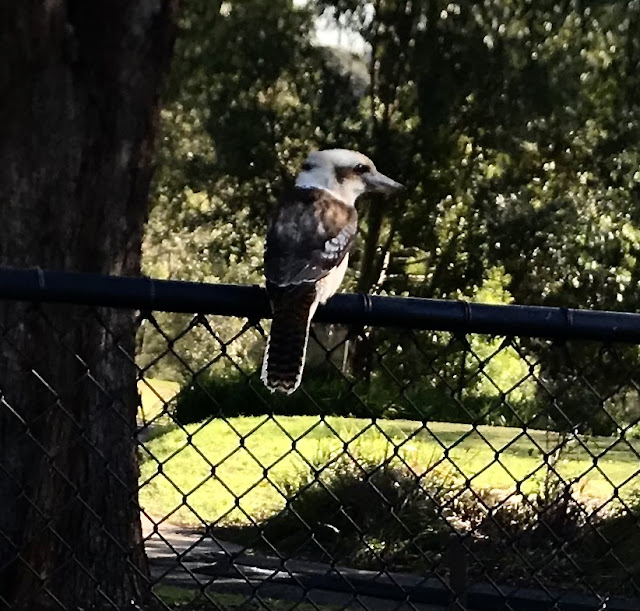
This Kookaburra is showing off his best side.

But the common nickname for this cheeky bird with a raucous voice is "Laughing Kookaburra." 

It's got to be the coolest bird on the planet. 

It's good-looking, has facial recognition abilities, a human personality type (thief), and outstanding vocal skills that mimic chuckling, crying, and laughter—which, when strung together, sounds like monkey chatter! 

Kookaburra at the Oval car park.

If you're old enough to remember the movie "Tarzan The Ape Man," starring Johnny Weissmuller like I am, the jungle sounds used in the film came from recorded stock sound effects of Kookaburras.

These recordings are also in many other movies involving jungle scenes, such as "The Raiders of the Lost Ark," "Cape Fear," "The Lost World, Jurassic Park," "The Twilight Zone," and many more, including Sistah in Oz's favorite, the haunted forest scene from "The Wizard of Oz!"  

Forest areas in Australia are called "bush!

Australia's indigenous communities regard the Kookaburra as a messenger of good luck, joy, happiness, and fertility - good vibes!

Before visiting Sydney, I only knew about Kookaburras from a song I learned at Brownie camp, "Kookaburra Sits in the Old Gum Tree." 

Marion Sinclair wrote it as a nursery rhyme.

My sister, Terry, and I loved singing the song at camp, but I admit I only really understood the lyrics after I got to know the bird! 

A Kookaburra sitting in a gum tree, aka, eucalyptus.

crafty meat-eating bird that steals your lunch  . . .  

A talented, noisy bird, skillful at mimicking a repertoire of jungle sounds . . . 

A brilliant bird with an extraordinary memory that can recognize human faces . . . 

. . .  I am NOT in Kansas!


Please sign into Google to leave a comment.